
Education Corner
 Hepatitis A & B Combined Vaccination
 Who should inject Hepatitis A & B vaccine? For those who are non-immune, never have Hepatitis A & B vaccination and at risk of both Hepatitis A & B infections. How many doses do I need to inject ? Three doses course The second injection is given 1 month after the first The third injection is given 6 months after the first
2018.12.21 MMR Priorix Vaccine
 Why do children need to inject MMR vaccine? Measles, Mumps and Rubella are infectious diseases that are transmitted by droplets or direct contact with respiratory secretions of infected persons. Therefore, it is recommended all infants and children should receive MMR vaccine, to effectively prevent the above three infectious diseases. What are the possible side effects after vaccination? Some children may experience fever or skin rash 5 to 12 days after injection, but these symptoms will not persist for long. A minority of children may develop transient swelling of lymph glands, but the cases are very rare.
2018.12.21 De Quervain's disease
 Mother’s Thumb Syndrome (De Quervain’s Tenosynovitis) Commonly known as "Mommy’s Thumb," De Quervain’s tenosynovitis is a condition characterized by inflammation and pain around the tendons on the thumb side of the wrist. Many patients, especially new mothers, experience this due to repetitive thumb and wrist movements, such as holding and caring for an infant. This leads to wrist pain, swelling, and difficulty performing everyday tasks. What Are the Causes? Chronic overuse or repetitive thumb and wrist motions. Hormonal changes during pregnancy. Poor wrist and thumb positioning when lifting a baby or performing daily tasks. Certain professions involving frequent thumb use can also be affected. What Are the Symptoms of acute Mommy’s Thumb? Wrist pain and tenderness on the thumb side, even when the thumb is at rest. Redness and swelling around the wrist. Severe pain when gripping or rotating the wrist. A sensation of warmth and reduced skin folds around the wrist due to swelling. What Are the Symptoms of chronic Mommy’s Thumb? Mild swelling with pain occurring mostly during wrist movement or exertion. How to Perform A Self-check? Extend your arm and make a fist with the four fingers wrapped over the thumb. Gently press the thumb toward the little finger. If this causes or worsens pain around the base of the thumb, it indicates possible Mommy’s Thumb. This is also a thumb muscle stretching exercise. How to Cure Mommy’s Thumb? Acute cases: Rest and ice application. Elevate the wrist above heart level for about 30 minutes multiple times a day. Chronic cases: Massage forearm muscles. Use heat therapy. Rest the wrist. Perform recommended thumb stretching exercises. If symptoms persist, consult a doctor who may prescribe painkillers, anti-inflammatory drugs, diuretics, or topical pain relief creams. Physical therapy may also be recommended. Physical Therapy: Ultrasound therapy, interferential therapy, acupuncture, and magnetic therapy can reduce inflammation and promote tissue healing. Magnetic therapy uses high-frequency magnetic fields to accelerate recovery. Typically, 6–8 treatments for acute cases and 10–12 for chronic ones are required. Exercises: Finger extension strengthening: Use a rubber band around all five fingers, spread them apart for 10 seconds, then relax. Repeat for about 3 minutes, 2–3 times daily. Wrist flexor stretch: Extend the left forearm with the palm facing up, and gently pull the left palm upwards with the right hand, holding 5 seconds. Repeat 20–30 times. Supportive devices: Wear wrist braces and use kinesiology tape to protect injured joints during recovery. Mommy’s Thumb generally improves with rest and appropriate treatment, but persistent pain should prompt further medical evaluation. Hong Kong Registered Physiotherapist The information on this website is provided for educational purposes only.You should consult your doctor regarding surgical methods and not rely solely on the information provided here.
2018.12.21 Plantar fasciitis
 Have you ever experienced stabbing pain in your heel when getting out of bed? If you often stand for long periods or are overweight, this sensation may be familiar and could be a sign of plantar fasciitis. This condition is caused by overuse or injury of the plantar fascia, leading to acute or chronic inflammation. Along with taking anti-inflammatory and pain medication, physical therapy and stretching exercises can promote faster recovery. Why does plantar fasciitis occur?The fan-shaped plantar fascia is made of thick elastic fibrous tissue. It attaches at the front to the five metatarsal bones and at the back to the inner heel bone, tightening the foot and heel to form the arch. The plantar fascia helps maintain the foot arch, absorb shocks during walking, and provide elasticity and torsion. However, inflammation can be caused by: Prolonged standing, obesity, or excessive walking leading to abnormal foot pressure and overuse or injury of the plantar fascia, sometimes thinning the heel fat pad, causing acute or chronic inflammation. Flat feet reduce the arch height, causing overuse and inflammation. Some patients with heel bone spurs have thicker plantar fascia than usual. Spinal or pelvic issues, such as unequal leg length or lumbar disc herniation, cause uneven weight-bearing on the legs. What are the symptoms of plantar fasciitis?Symptoms are distinct, including stabbing heel pain when putting weight on the foot after getting out of bed, intermittent pain during walking which may lessen after about 30 minutes but worsens after walking for two to three hours, and swelling with tenderness on the inner plantar side. How is plantar fasciitis treated with physical therapy?Besides medications and steroid injections prescribed by doctors for pain and inflammation, physical therapy accelerates recovery. Physiotherapists assess the patient’s condition and provide individualized treatment depending on acute or chronic phase, including magnetic therapy, ultrasound, interferential current, heat, and cold therapy. Six to eight sessions are typical for acute cases, while chronic cases may require 10 to 12 sessions, supplemented with appropriate stretching exercises. How can I prevent plantar fasciitis?Calf stretches relax calf muscles and reduce excessive pull on the plantar fascia. For example, support yourself with both hands on a wall, place the affected leg behind you, and lean forward to feel a gentle stretch. To stretch calves, stand on the edge of stairs with the front of both feet while keeping knees straight, lower the heels below stair level, and push the body downward. Daily care and prevention include: Avoid prolonged standing and walking to reduce foot pressure. Minimize barefoot walking. Avoid walking on hard floors or forceful stepping. Wear cushioned shoes or use appropriate arch-support insoles. After walking, apply ice to the heel for about 15 minutes to diminish inflammation. Hong Kong Registered PhysiotherapistInformation on this website is for educational use only.You should consult your doctor regarding surgical methods and not rely solely on website information.
2018.12.21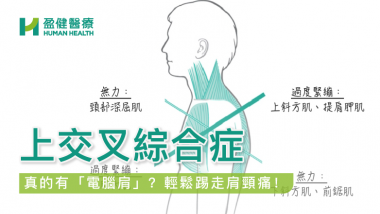 Upper Crossed Syndrome
 Is “Computer Shoulder” Real?! - Upper Crossed Syndrome Lately, the term “computer shoulder” frequently appears in TV ads, but does this condition really exist? For those working long hours from 9 to 5 plus overtime, long periods of computer use combined with poor posture often lead to neck and shoulder pain and muscle tension. Studies find that about 60% of computer users experience shoulder or neck discomfort. However, medically speaking, there is no such condition as “computer shoulder.” What advertisements refer to is most likely Upper Crossed Syndrome (UCS). When sitting in front of a computer monitor for long hours, it is natural to extend your neck, hunch your back, and even raise your shoulders. Typical signs include:This poor posture not only makes you appear less confident but causes severe muscle pain in the shoulders and neck, making simple actions like looking up or raising your hands uncomfortable. Over time, it may even accelerate cervical spine degeneration. How to Prevent Neck and Shoulder Discomfort?Try these tips to reduce computer-related shoulder and neck discomfort and help overcome Upper Crossed Syndrome: TIPS 1: Start with Improving Your PostureAccording to Harvard University, posture improvement is crucial. Make an effort to strengthen the weaker muscles mentioned earlier: Pull your chin back – activate deep neck muscles Keep your chest out and spine straight – engage lower back muscles Remember to keep shoulders relaxed. Rest your arms on the desk or chair armrests to reduce shoulder strain. Maintaining this good posture consistently can make shoulder or neck pain much less likely! TIPS 2: Adapt Your Environment Harvard also warns that improper monitor height, causing the neck to jut forward, can cause muscle strain or even damage to cervical vertebrae, nerves, and intervertebral discs. Check your monitor position—its top should be level with your eyes. Support your lumbar spine using cushions or chairs with lumbar support to prevent slouching and help maintain chest posture, improving UCS symptoms. TIPS 3: Take Regular Breaks and MoveEven with good posture and an optimized workspace, prolonged computer use strains your shoulders and neck. Change position every 15 minutes. Get up, drink water, walk to the restroom to give your shoulders and neck a break. Perform simple exercises to relax your muscles: Shoulder and neck stretches: 10 reps per side, hold each for 10 seconds Chest stretches: open arms wide, hold for 10 seconds Strengthen deep neck muscles Strengthen shoulder blades and back muscles: use water bottles as dumbbells, pull hands backward, hold 5 seconds, 10 reps Follow these three tips, and Upper Crossed Syndrome will become a thing of the past! Hong Kong Registered PhysiotherapistThe information on this website is for educational purposes only.You should consult your doctor regarding surgical methods and not solely rely on this website’s information.
2018.12.21 Back Pain
 Whether you are a white-collar worker or a laborer, you’ve probably experienced occasional back or waist pain. In fact, back pain affects people from all walks of life. Maintaining good posture and performing regular stretching exercises can help relieve and prevent discomfort. However, if you experience symptoms such as sciatica or numbness in the legs, it is important to seek medical evaluation to identify the underlying cause. Doctors may recommend physical therapy for those who need it. Causes of Back Pain Back pain is a common ailment in urban life. Even retirees and homemakers who don’t work long office hours may experience stiffness or discomfort in the lower back. Causes include falls, lifting heavy objects, overwork, poor posture, bone spurs, and age-related degeneration of the spine. Some patients with kidney disease or osteoporosis may also suffer from back pain. Structure of the Lower Back Protecting the spine is crucial because the lower back has a complex structure composed of the sacrum (tailbone), five lumbar vertebrae, and two pelvic bones, all connected by ligaments and muscles. Between each vertebra are intervertebral discs, blood vessels, and spinal nerves. The nerves that branch out from the lumbar spine control movement and sensation in the legs. Therefore, pain or numbness in the legs can sometimes originate from problems in the lower back. Symptoms of Back Pain Muscle soreness in the lower back or legs, stiffness, and reduced range of motion Sharp pain when coughing or sneezing Sciatica or femoral nerve pain Compression of spinal nerves may cause weakened reflexes, muscle fatigue, or numbness in the legs Treatment and Care For chronic back pain, apply heat or use medicated pain-relief patches. For acute pain, use ice packs to reduce inflammation. If symptoms such as numbness or persistent pain continue, consult a doctor. The doctor will perform an examination, and possibly X-ray or MRI imaging, to determine the cause. Treatment may include painkillers, topical medications, and physical therapy if needed. Physical Therapy for Back Pain Depending on the patient’s condition, physical therapists may use: Heat therapy: Applying a heating pad to relax muscles. Interference (electrical) therapy: Uses special electrical waves to block pain signals to the brain, improve circulation, and relax tissues. Traction therapy: Applies controlled weight to relieve nerve compression in the lower back. Ultrasound therapy: Promotes blood flow and relaxes muscles and tendons using sound waves.Typically, acute pain requires 6–8 sessions, while chronic cases need around 10–12. Manual joint adjustment: Helps realign displaced vertebrae. Exercise therapy: Gentle stretches such as: Lying face down and pushing up the upper body with the hands (cobra stretch). Lying on the back with knees bent, gently rocking from side to side.(Repeat each movement ten times.) Acupuncture therapy Posture training Prevention Tips Wear a lumbar support belt if necessary. Maintain proper posture: The spine naturally forms two S-shaped curves. Poor posture exaggerates or flattens these curves and accelerates degeneration. When standing, keep your chest up, shoulders relaxed, and back straight. When sitting, place both feet flat on the floor, sit upright against the chair back, and avoid crossing your legs. Adjust chair and desk height appropriately. Use a firm, supportive mattress when sleeping, whether lying on your back or side. When lifting heavy objects, keep your back straight and use your legs to lift—use a cart if needed. Maintain a healthy weight. Pregnant women should pay attention to proper posture. Do regular exercises, such as lying flat and alternately pulling each knee to the chest ten times per side, to relax lower back muscles. Registered Physiotherapists in Hong KongThe information provided on this website is for educational purposes only.You should consult a doctor about medical treatments and not rely solely on online information.
2018.12.21