
Education Corner
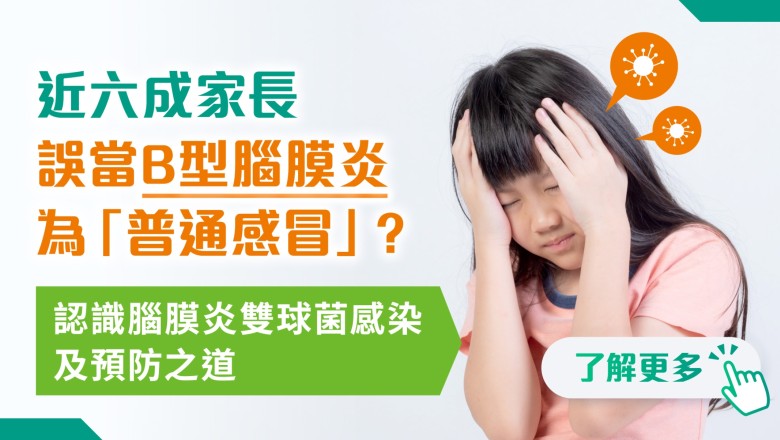
In recent months, meningococcal infection has attracted widespread international attention, with the UK experiencing a large-scale outbreak earlier this year. In Hong Kong, as of the end of May this year, 5 cases of invasive meningococcal disease have been recorded, including a 3-year-old boy and a 9-year-old girl, both of whom were in serious condition upon hospitalisation. This highlights that the risk of infection among young children must not be overlooked. With the summer travel season approaching, coupled with overseas students returning to Hong Kong and parents frequently taking their children to high-risk destinations, the public should remain vigilant.
Below, Human Health has compiled essential information about meningococcal infection to help you understand and prevent it early.
Widespread Lack of Awareness Among Parents — Nearly 60% Mistake It for a "Cold"
To gauge Hong Kong parents' and teachers' awareness of meningococcal disease and their attitudes towards prevention, the Hong Kong Association for Early Childhood Educators interviewed 300 parents and teachers in May this year. The results are worrying: Hong Kong parents travel frequently, with 86% of surveyed parents having taken their children abroad in the past year, 64% of whom fall into the "high-frequency traveller" category, travelling either monthly or quarterly.
However, parents' average awareness score for meningococcal disease was only 3.84 out of 10 — a notably low level. Nearly 60% of parents mistakenly regarded the disease as a "common cold," thereby overlooking its high fatality rate and risk of long-term complications. This gap in awareness directly affects vaccination intentions. The survey revealed that up to 78% of parents had never had their children vaccinated against meningococcal disease, while a further 38% were completely unaware that a preventive vaccine even existed.
Condition Can Deteriorate Rapidly Within 24 Hours
What makes meningococcal infection so dangerous is precisely how "swiftly it strikes and progresses." Early symptoms resemble those of a cold, patients may only experience loss of appetite, fever, nausea, or vomiting. Combined with young children's limited ability to express themselves, diagnosis is more difficult than in older children, and parents may easily underestimate the situation.
However, the condition can deteriorate rapidly within 24 hours, presenting with haemorrhagic rash, neck stiffness, photophobia, and even seizures and in severe cases, it can be fatal. Medical data show that the mortality rate of this disease reaches 10 to 15%, and among survivors, about 20% will suffer serious complications, including amputation, deafness, brain damage, and intellectual impairment with lasting consequences.
Cases Doubled Last Year, with Group B Accounting for Over 70%
Looking back at 2025 data, Hong Kong recorded 11 cases throughout the year, more than double the 5 cases in 2024. Of these, 73% were caused by Meningococcal Group B, and approximately 22% (4 cases) were critically ill and required admission to intensive care.
Notably, this disease poses a particularly severe threat to infants and young children. According to the Global Burden of Disease (GBD) Study 2021, meningitis has the highest fatality rate among infants and young children (especially neonates and those under 5 years old). Among patients under 20 years of age, children under 5 accounted for approximately 81% of deaths. This clearly shows that the younger the child, the higher the risk, a fact parents must not overlook.
Two Types of Vaccines Complement Each Other — They Are Not Interchangeable
Many parents may assume that once their child has been vaccinated, they can rest easy. However, there is an important concept that must be clarified: the Meningococcal Group B vaccine and the ACWY vaccine offer complementary protection, they do not replace each other.
The commonly administered ACWY vaccine covers meningococcal serogroups A, C, W, and Y, but does not include Group B. In other words, even if your child has received the ACWY vaccine, additional vaccination against Group B should still be considered based on individual risk to achieve more comprehensive protection. Data show that both vaccines are approximately 90% effective in preventing meningococcal infection in children, a level of protection that is trustworthy.
For high-risk individuals, including travellers heading to endemic or outbreak-affected areas, as well as overseas students on long-term stays. Vaccination should be considered based on the destination's epidemic situation and personal health, in consultation with a doctor. Parents may also wish to take advantage of the summer travel season or the start of the new school year to consult their doctor in advance and arrange appropriate meningococcal vaccination for their children, strengthening protection and reducing the risk of infection and severe illness.
Human Health Meningococcal Group B Vaccination Service
Rather than regretting missed prevention when infection strikes, build a line of defence for your child's health early. We offer Meningococcal Group B vaccination using the vaccine manufactured by GSK (GlaxoSmithKline) of the UK, suitable for infants from 2 months of age and above (for both males and females). With multiple clinic locations across the city, we make it convenient for you to book a nearby appointment. Prior to vaccination, our professional medical team is also available to provide consultation and assess suitability, so you can make your decision with confidence.
To learn more or book an appointment, please visit the link below or get in touch with us.